|
Baguio Hotels and Accommodations:
Baguio City, Islands Philippines
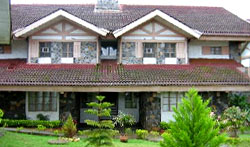
Baguio Highlands Hotel Resort
Green Valley Village, Sto. Tomas Rd, Dontogan, Baguio City, Philippines
Baguio Highlands Hotel Resort Bookings
Baguio City Travel Deals
Baguio Highlands Hotel Resort nestled on half hectar property located at secured and peaceful residential community of Green Valley Village, dubbed as the coldest place in Baguio and about 5 minutes drive from the city proper. The Baguio Highlands is not only differentiated by its American architecture and coy interiors, but also blessed with an environment filled with pine trees and lovely flowers. A few meters away is a trek up to one of Baguio City' hot spots, the Mount Santo Tomas, is a hiker's delight.
The peak is 7,500 feet high and all the 16 Villas of the resort provide a perfect view of the mountain range. Each villa has its own fireplace, fully furnished with all the dinnerware and cookware you need and comes in 3 or 4 spacious bedrooms. There is much to say about our Villas but it can be simply described as a home away from home.Witness the clouds kiss the earth from the Condotel, with 20 rooms to accommodate our guests. It consists of studio type, 2, 3 or 4 bedroom units, catering to the varied needs of individual, families and group.
Featured Baguio Hotels - Recommended Baguio Accommodations
Travel Quotes: We shall not cease from exploration, and the end of all our exploring will be to arrive where we started and know the place for the first time. T. S. Eliot
It is better to travel well than to arrive. Buddha Pulutan Philippines Cuisine
Pulutan (from the Filipino word pulutin which literally means "something that is picked up") is a term roughly analogous to the English term "finger food". Originally, it was a snack accompanied with liquor or beer but has found its way into Philippine cuisine as appetizers or, in some cases, main dishes, as in the case of sisig.
More details at Pulutan Philippines Cuisine Southern Philippine Cuisine
In Mindanao, the southern part of Palawan island, Sulu and Tawi-Tawi, dishes are richly flavored with the spices common to Southeast Asia: turmeric, coriander, lemon grass, cumin, and chillies — ingredients not commonly used in the rest of Filipino cooking. Being free from Hispanicization, the cuisine of the indigenous Moro and Lumad peoples of Mindanao and the Sulu archipelago has much in common with the rich and spicy Malay cuisines of Malaysia and Brunei, as well as Indonesian and Thai cuisines.
More details at Southern Philippine Cuisine |
|