Yapak Boracay
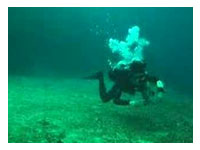
Yapak Dive Site Boracay
This area is at the north of Boracay and offers some excellent opportunities to see large marine life. The two walls of Yapak are the most exciting sites around the island, but due to rough waters and strong currents, they are for the experienced only.
Descending from 30-60m, the walls have a vast array of soft corals and gorgonians. You're sure to run across snappers, surgeonfish, groupers and sweetlips as well as having the chance to see whitetip and gray reef sharks. Hammerheads and manta rays are spotted occasionally.
Bat Cave
On the eastern side of the north point also offers some challenging diving. The site is made up of a series of caves that eventually end with the main one itself. Marine life includes lobsters, sea snakes and a multitude of smaller tropical fish. Diving here should only be undertaken in the best of conditions as seas can be rough and currents strong.
Balabag Boracay
Situated on the west coast of Boracay, this area offers some superb diving. Probably the most famous site is Friday's Rock. Close to the shore and at a depth of 18m, this boulder houses a wide variety of fish life including wrasses, tangs, damselfishes, emperors, stingrays and scorpionfish. There is a well-known fish feeding station here which allows close contact with the marine life and excellent opportunities for photography.
Slightly to the north are two walls named Punta Bonga 1&2. The shallower of these drops to 24m and you can expect to see a good variety of soft coral as well as triggerfish, groupers, moray eels and lionfish. The deeper wall starts at 30m and descends to 50m. Gorgonians are prolific and you have every chance of encountering stingrays, tuna, barracuda and sharks
.
Other sites in this area include Angol Point which is particularly suitable for beginners, snorkelling and photography and Camia which is a 30m long cargo boat, sunk in 2001 and now developing into a good artificial reef.
Crocodile Island Boracay
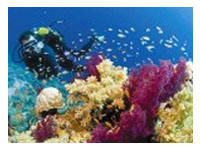
Crocodile Island Dive Site Boracay
Situated on the southern tip of Boracay, this island resembles the above reptile when viewed from a distance, hence the name. Currents can be strong in this channel between Boracay and Panay Islands, so care should be taken and the area is not for novices. The diving, however, is spectacular and you are likely to come across pretty much anything.
The wall at Crocodile Island slopes gently from 5-24m and the currents allow a wide variety corals to survive. Fish life is diverse and includes wrasses, sweetlips, groupers, snappers and banded sea snakes.
There are two other sites worthy of mention in the vicinity. Laurel Islands 1&2, which offer gently sloping walls with a good variety of coral and diverse fish life. The larger of the islands has an 8m swim-through that is worth exploring. Again, currents can be very strong here. Channel Drift, as its name suggests, offers some great drift dives through canyons and crevices where you can encounter whitetip sharks and trevallies.